
QUI offers irrefutable, data-driven evidence to bolster prosecutions, support defenses, secure settlements, and validate whistleblower claims. Our technology equips attorneys with precise insights into physician practice patterns, enabling both plaintiff and defense teams to assess risk, target arguments, and uncover or defend against allegations of excess billing.
With QUI standing as a co-relator alongside whistleblowers, attorneys gain the strongest possible evidentiary foundation for healthcare fraud. Whether preparing for trial or negotiating settlements, QUI delivers the most advanced detection tools available today.
Physician Practice Pattern Report: Used by Plaintiff and Defense Attorneys in Medical Malpractice Cases
What if you knew exactly where your medical malpractice defendant or client ranks among his or her peers?
When QUI’s National Peer Ranking places a physician at the bottom, that data may help support a malpractice or fraud allegation. When a provider’s risk level is elevated above 90 percent, it may signal exposure that must be addressed. And when a practice pattern falls four standard deviations outside the national norm, it can offer strong support for an argument that the care was reckless or unsupported. Conversely, when a physician ranks within normal bounds or matches national averages, that same data can be a powerful tool for defending appropriate care and securing a favorable outcome.
For the first time, attorneys have access to objective, national-level data that can inform strategy, shape discovery, and clarify a physician’s true practice pattern.
Just imagine receiving a report that:
Identified a Nurse Practitioner in Phoenix who applied $176 million in ultra-expensive CTP to every patient. His practice ranked 21.5 standard deviations from the norm. QUI’s Redline Alert flagged his behavior as extreme.
- Highlighted a physician in New York named in a malpractice suit whose treatment decisions aligned closely with national best practices. QUI’s analysis showed his utilization rates were within 0.3 standard deviations of the norm, supporting a strong clinical defense.
Listed the 53 vascular surgeons who submitted $213 million in questionable claims to CMS. These surgeons performed high-cost tibial interventions on nearly every patient without clear medical necessity.
Whether your strategy is to demonstrate a pattern of overuse or to defend against such claims with factual comparisons, QUI equips attorneys with data that helps guide the legal narrative. Our clients use QUI’s Physician Practice Pattern Reports and National Data Extraction Reports to strengthen their cases, reduce uncertainty, and either pursue or defend against serious allegations with clarity.
QUI’s analytics have supported cases that drew national attention. The New York Times published “Profiting from Risky Atherectomies That Can Lead to Amputation,” a piece that uncovered questionable vascular procedures. ProPublica followed with “The Wild Wild West,” reporting how physicians reaped large payments while patients suffered preventable harm.
Dr. Marty Makary of Johns Hopkins University, a co-developer of QUI’s technology and a nationally recognized health policy expert, commented in ProPublica: “Vascular medicine now is the frontier of the Wild West. People are flying blind walking into the clinics of these doctors with egregious practice patterns, and we know that their pattern is indefensible.”
In one case, a man had his leg amputated after repeated invasive treatments for mild pain. In another, a 62-year-old woman died following an unnecessary procedure. QUI’s reports provide attorneys with early warning signs and post-event analysis alike. Whether you are assessing a new case or preparing for trial, this level of insight can help shape how your argument is built or countered.
QUI’s Physician Practice Pattern Report helps attorneys answer critical questions:
How does this provider compare to national peers?
Is the practice pattern consistent with standard medical behavior?
Do red flags exist that indicate fraud, risk, or unnecessary intervention?
What is the probability that the provider’s pattern occurred by chance?
If financial excess exists, how much was likely billed beyond the norm?
QUI also provides excess cost analysis that assigns a financial value to patterns that fall outside the standard of care. For defense attorneys, this same analysis can help demonstrate that billing and treatment patterns fall well within national standards and that the physician’s approach was medically justifiable.
Our visual reports are designed to be jury-friendly. We include clear bar charts, risk gauges, and cost summaries that make complex data easy to present and easy to understand. Attorneys have described our reporting as the single most decisive tool used in pre-trial negotiations or in demonstrating care quality at trial.
If you provide us with your client or opposing party’s name and NPI, we will show you how they rank.
Whether your objective is to prosecute or defend, QUI helps you know the facts before you act. You will have confidence knowing whether the data supports your position and clarity to use that evidence effectively.
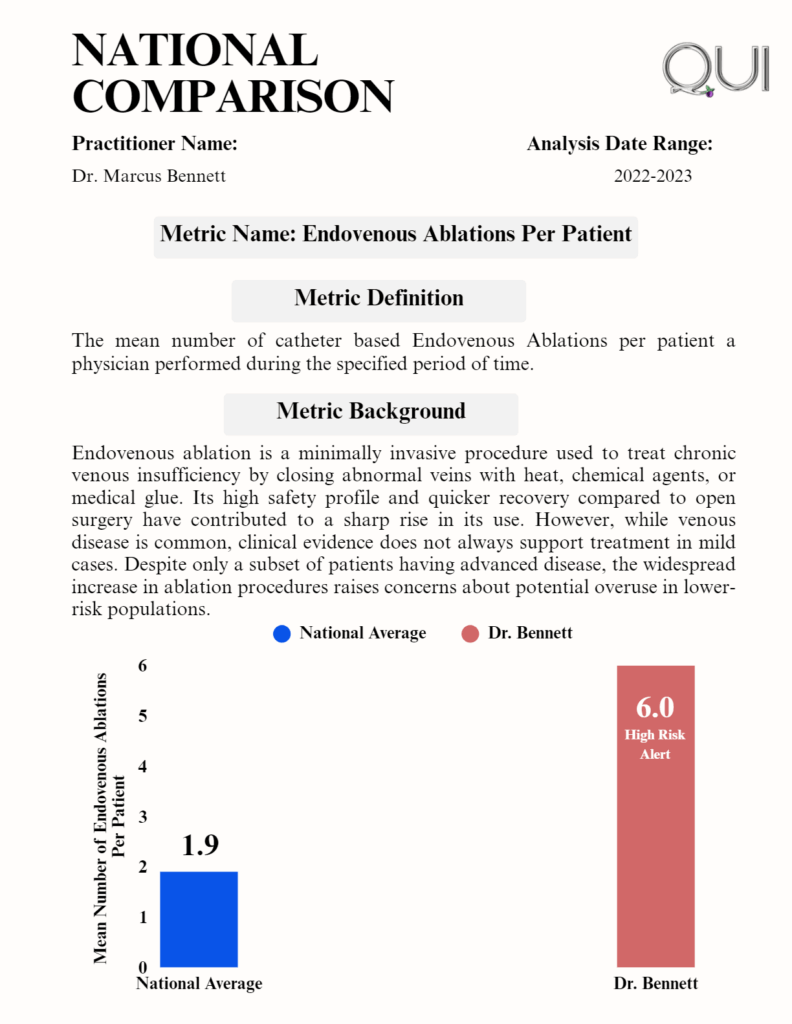
National Rank Comparison
The National Rank Comparison positions physicians against national benchmarks, providing a statistical and visual ranking of their practice patterns. This report highlights whether a physician’s behavior falls within normal variance or stands out as a high-risk outlier. By applying QUI’s disruptive pattern recognition algorithm, this report helps legal teams understand where a physician fits in comparison to their peers.
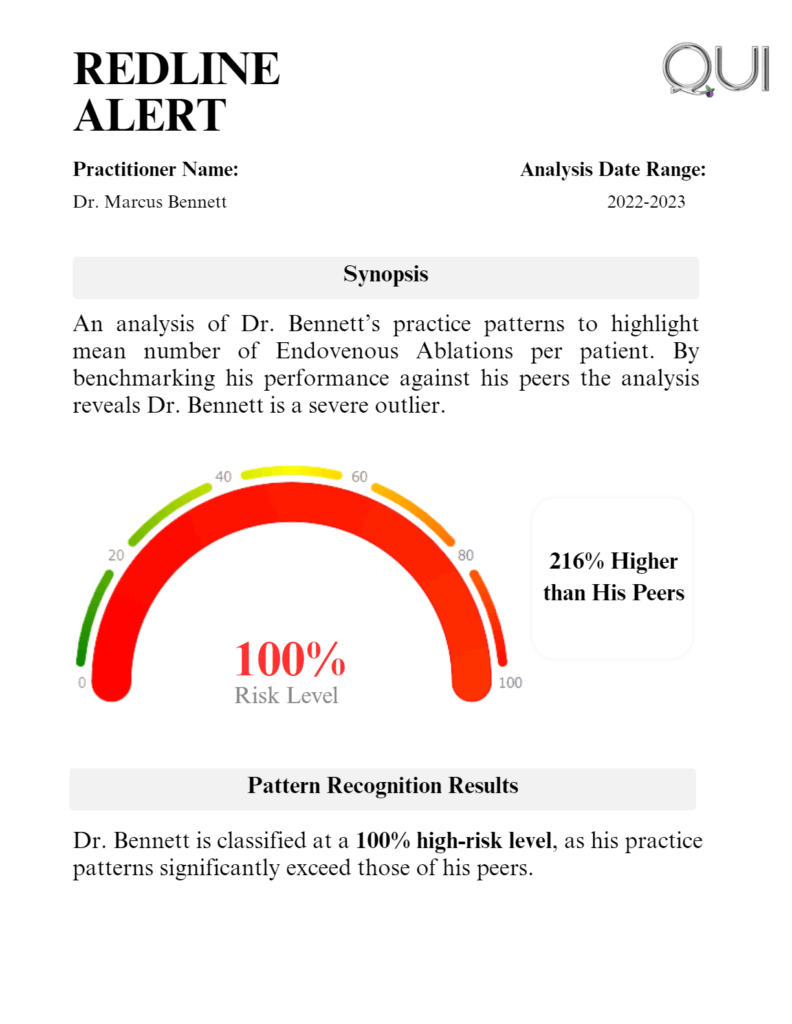
Tachometer
The Tachometer serves as a risk assessment, categorizing physicians based on deviation from best practices. By utilizing a redline alert system, this report identifies critical risk zones, visually depicting whether a physician’s practice fall into appropriate (green), concerning (yellow), or severe outlier (red).
The tachometer’s color-coded urgency scale simplifies complex statistical data, ensuring that trends are easily understood and effectively presented.
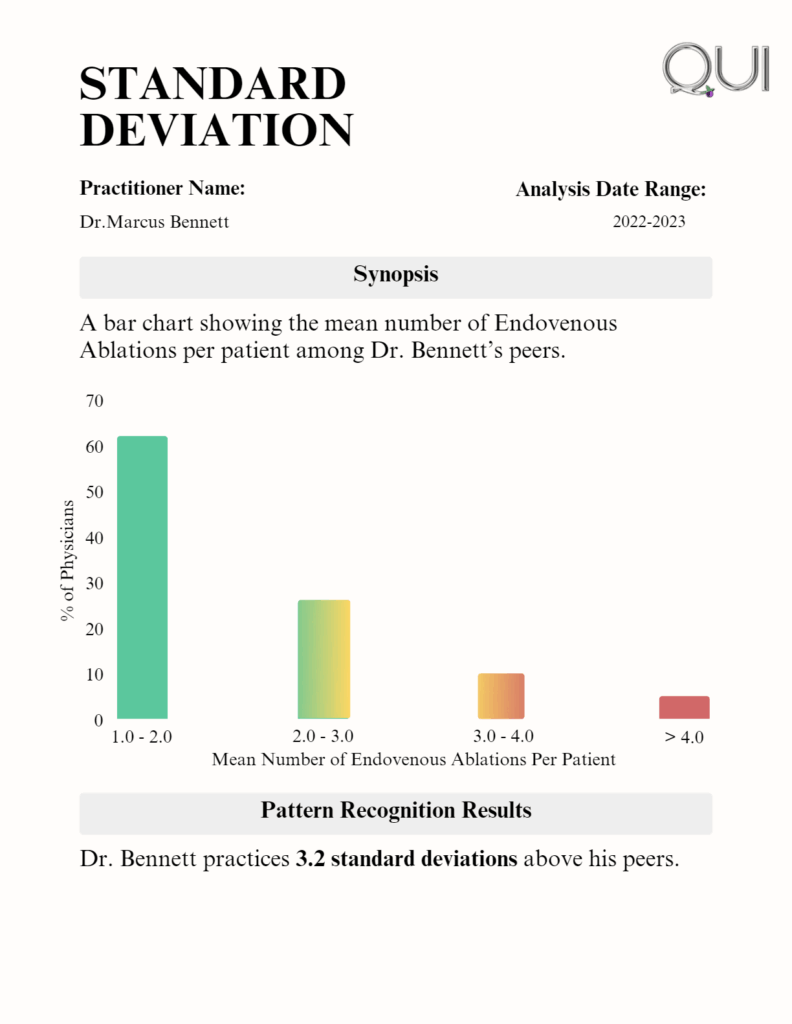
Physician's Standard Deviation
The Standard Deviation quantifies the extent to which a physician’s behavior deviates from the national mean, identifying outliers with statistical certainty. Physicians operating at three or more standard deviations above the average are high-risk—indicating patterns that far exceed normal industry fluctuations.
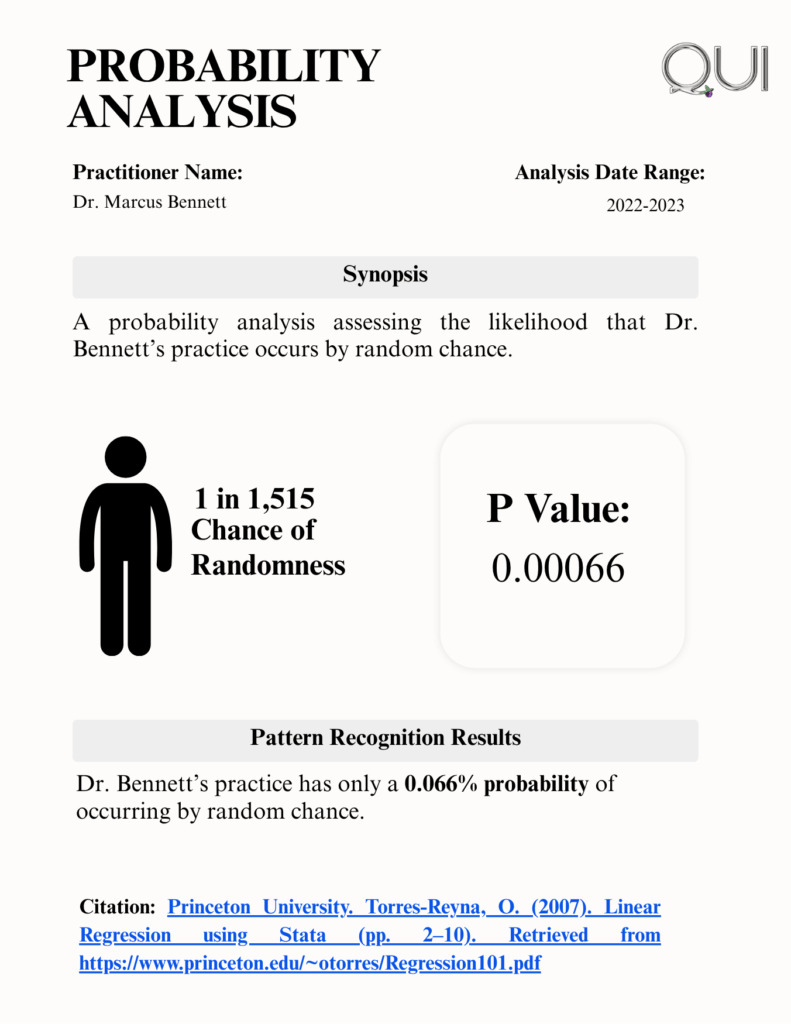
Probability Analysis
The Probability Analysis removes uncertainty by establishing that a physician’s practice patterns are not random occurrences. By applying a Probability Analysis, this model establishes statistical intent, showing whether a physician’s practice patterns demonstrate systematic overuse.
Physician's Billings in Excess of the Norm
The Physician’s Billings in Excess of the Norm Report demonstrates the cost of a physician’s practice patterns, calculating the economic impact of excessive interventions. This report breaks down the total cost burden caused by certain practice patterns, highlighting fraudulent or wasteful practices that inflate healthcare costs.

False Claims Act Attorneys use QUI
Don’t be passive. Starting now, use QUI to actively search for your next big case.
Attorney General John M. O’Connor finished his tenure with a series of settlements with opioid manufacturers, distributors and retailers, which created a combined recovery of >$900,000,000. So, it was ironic that John led QUI’s $900,000,000 False Claims Act lawsuit against Cellular and Tissue-based Products (CTP) clinicians, manufacturers and distributors.
How can you do the same?
- QUI accesses data 24/7/365. Our practice pattern algorithm sends us Red Line Alerts whenever physician practice patterns become indefensible by standards set by their peers. From the Alert, QUI creates an Executive Summary that we send to a small cohort of False Claims Act firms (click here if you want to receive QUI Executive Summaries).
- Together with your attorneys, AG O’Connor, clinical experts, and data analysts, we present our National Data Extraction Report. This report identifies Red Line Alert physicians by name, NPI, practice location, CMS billing activity, peer benchmarks, and the total amount of excess billing reimbursed by CMS.
- As mentioned earlier, the CTP case uncovered $900,000,000 in alleged Excess Billing. Dozens of CTP executives, scientists, and clinicians with independent first-hand knowledge were already gathering in online groups and forums, where QUI began our investigation. After conducting 26 interviews, we selected the best whistleblower who had been assembling damning evidence against clinicians, manufacturers and distributors for years.
- She became QUI’s co-relator, and our investigation uncovered dozens of Red Line physicians along with 20 CTP manufacturers and distributors.
In all of these ways, QUI invites you to enjoy the luxury of being an active and selective
FCA prosecutor:
- [Active] By using QUI to detect where false claims take place. No more waiting for an insider to come to you.
- [Selective] Our National Data Extraction Report and Executive Summaries let you pick and choose which cases are best for you.
Don’t wait for a whistleblower to walk into your lobby. Use QUI to actively search for your next big case. Together let’s eliminate $162BB in fraud, waste and abuse.
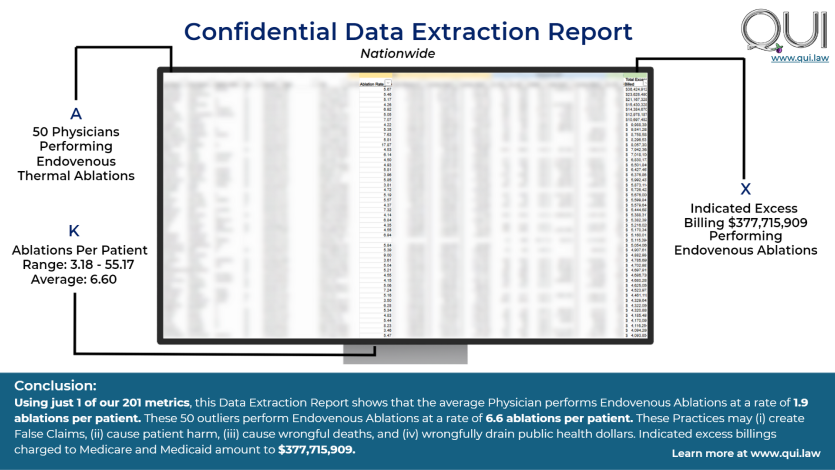
What Is the Data Extraction Report?
The National Data Extraction Report is a proprietary investigative tool developed by QUI to help government agencies, whistleblowers, and legal teams identify suspicious Medicare and Medicaid billing activity across the United States.
This report consolidates data from public CMS datasets, national provider registries, and advanced analytical models to surface outlier billing behavior. It includes:
- Named Red Line Alert Physicians
- National Provider Identifier (NPI) numbers
- Practice locations
- Detailed CMS billing activity
- Peer and specialty benchmarks
- Estimated excess reimbursements issued by CMS
Our team of attorneys, data analysts, and clinicians work alongside government entities and relators to ensure the report meets both investigative and evidentiary standards. Each report is tailored to support False Claims Act cases, internal audits, or state-level enforcement efforts.
The Data Extraction Report is a starting point for high-impact enforcement. It helps agencies and legal teams prioritize cases with significant financial exposure and strong statistical anomalies—turning billions of lines of healthcare data into actionable intelligence.
Investigative Services
As the relator, QUI provides specialized investigative support for False Claims Act cases. Our investigations help to identify credible co-relators/whistleblowers, who offer first-hand original evidence that support our cases. QUI’s empirical data combined with the first-hand original evidence brought by the whistleblower provides QUI TAM prosecutors with a compelling narrative.